Saturday, February 27, 2016

more honey

honey IMG_5231
honey IMG_5203
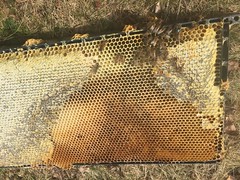
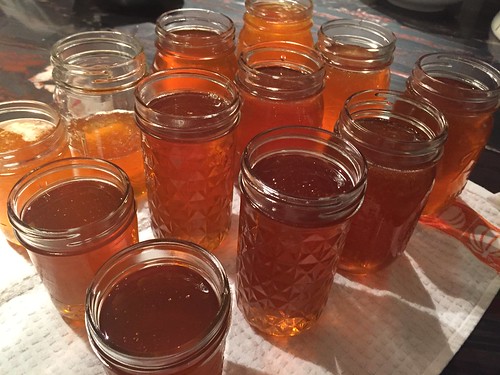
Yesterday I bottled 10 pints, 15 lbs, of honey for us to eat. It's spicy and sweet, medium amber. Really good. I think better than my September batch of honey, which was collected in a super and probably all Pepperbush honey. Pepperbush, a white flowered shrub, was in full bloom around the pond in August and September. It gives a floral, very mild honey. I took this new honey from frames throughout the hive, so it's a mix of flower nectars collected throughout the season. Beautybush, Silverbell, Black locust, apple, Ajuga, clovers, purple loose strife, and fall asters and goldenrods.

Wednesday, February 24, 2016

dismantling my dead hive

Greg wrote to me Monday to say he was sorry I lost a hive. He said, "I've been told this is the riskiest part of the winter because brood is expanding and the overall population may still be declining. That means there is more brood to protect and keep warm during very cold spells." Greg also mentioned the tarps I put on my hives during the recent cold snap, saying that moisture in an airtight hive can be more deadly to bees than cold.

Well, I was very sad to see my hive go. I wrote back to Greg that I think the hive was dead before I wrapped it as there was a large pile of dead bees on the ground that day. I think, as he said, they didn't have enough bees to keep brood or adults warm. I think the hive probably died soon after I moved it. It was in a cold, damp location. I think the number of bees declined in the fall because there was too much honey and no room for brood in the top box where the bees were located. I probably should have moved frames around to give them room for brood at the top of the hive.

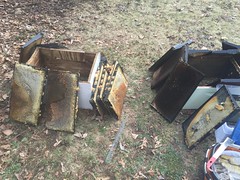
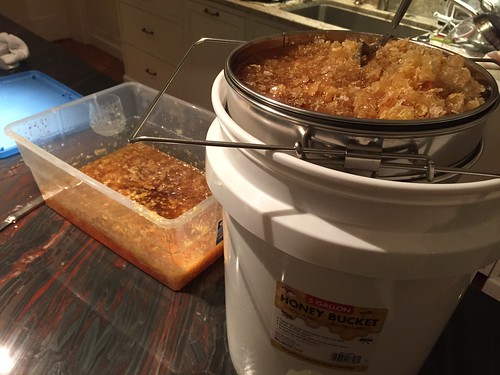
Sunday I took the tarp off, opened the dead hive and took it apart. I took out about 50 lbs of honey. I'll save most for my new package coming mid-April and I have about 20 lbs for myself. I scraped off the best sections of honey. It's in a container now waiting for a sieve and bucket I ordered. It's really nice spicy honey.

I took a lot of photos as I dismantled the hive. Sad to see the dead bees.

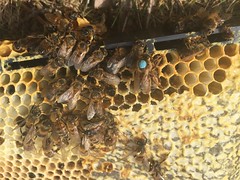
- The marked queen was there with many other bees around her.
- There was a lot of capped and uncapped honey.
dead hive IMG_5155 dead hive  IMG_5156

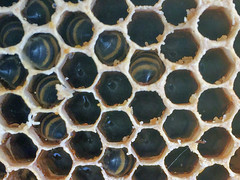
- A number of dead adult bees were nose down in cells.
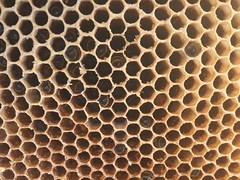
dead hive IMG_5157 dead hive IMG_5157 - Copy

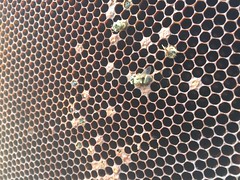
- There was dead brood emerging and about to emerge though no younger brood.
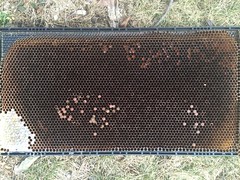
dead hive IMG_5177 dead hive IMG_5162

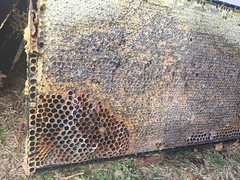
- There was mold and moisture in the lower box.
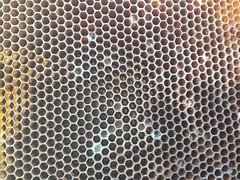
dead hive IMG_5167 dead hive IMG_5179

- I found one Varroa mite on the abdomen of a dead bee. It's the first mite I've seen after looking at thousands of my bees on photos, so I don't think mites killed the hive.
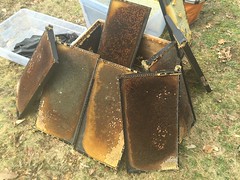
dead hive IMG_5161 dead hive  IMG_5160

About the mold, I think it grew when the tarp restricted airflow in the dead hive for the past week and maybe it had been building up at the previous location when bees were alive but had low activity. I read at Honey Bee Suite that mold happens in bee boxes in winter when they're not as active and the bee will clean it up as they expand (two good posts: moldy combs and mold during winter. If they were dead 2 weeks before I opened the hive, I imagine mold would grow in that time. I don't think there was any foulbrood, I hope not. It didn't smell bad at all. I think the white mold in some cells was on pollen grains, not larvae. So I'm planning to save the frames for feeding bees.

I hope my other other hive didn't get as much mold. It is very active now. I took their tarp off that hive on Sunday too. On the next warm day I would like to do a hive check and see if the frames of this hive need to be rearranged to give them room for brood. I can tell by it's weight that it's also very full of honey.
Friday, February 19, 2016

hive check - one's alive, one's dead

It's been 3 weeks since I checked my hives and moved them. The weak hive is dead. No live bees, though lots of honey. The top box seems like about 50 lbs. My stronger hive is doing well. Maybe even more bees than last check. At least similar numbers. I checked it without gloves, face netting, or hive tools, so I didn't look too long. I'm glad they survived our brutally cold (-12 F) and windy (gusts to 30 mph) night.

I will work on wrapping up and securing the honey-filled frames from the dead hive. I plan to use these to feed my bees this spring. I have a package coming mid-April. I want to see if I can get them going without feeding sugar water.

I left the tarp on the hives for now. I think I'll leave it a couple more weeks until the weather is warmer and more settled. I suspect my weak hive died from too much damp drafty air coming off the pond and from being in a location with no winter afternoon sun. So now my live hive has both draft protection and afternoon sun.

Saturday, February 13, 2016

bee hives wrapped for cold

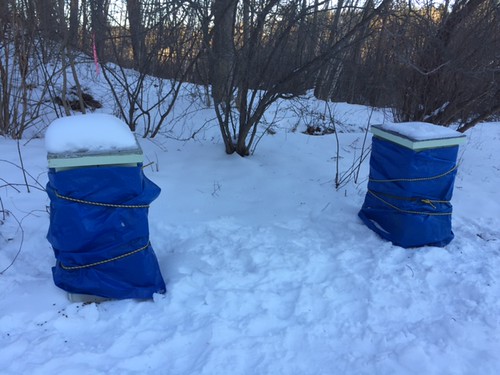
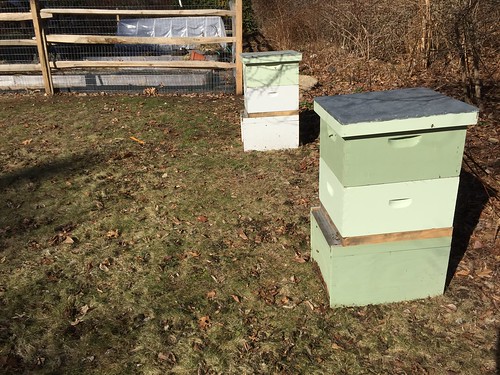
I wasn't planning to wrap my bee hives. At my bee club people usually just add insulation to the top, which I did back in November. But this is way colder than we're used to! Predictions for tonight are 5 to 15 below 0 F (-20 to -26 C) with a gusty wind to 35 mph. So I wrapped both hives in a tarp. At least this will cut down any drafts getting in the openings.

bee hives wrapped for cold IMG_1426

As I was wrapping them, I noticed a big pile dead bees next to my weaker hive. Not so good. There were some by the stronger hives, but nowhere near as many. I went ahead and placed my order for a package of bees for mid-April from Rick at NEBees. He brings three truckloads of nucs and packages up from Georgia in April. His first truckload in early April is already sold out. I'm glad I've got mine ordered now. If, by any chance there are still bees in the weak hive, or either hive, I can combine them I suppose.

Friday, January 29, 2016

bee photos

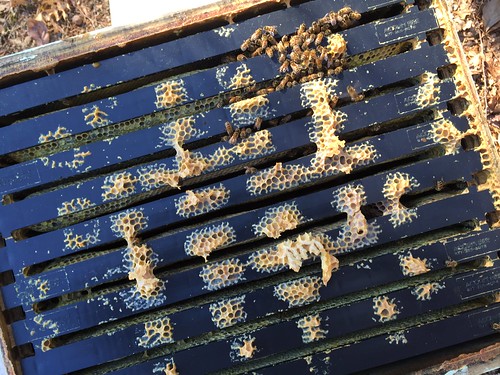
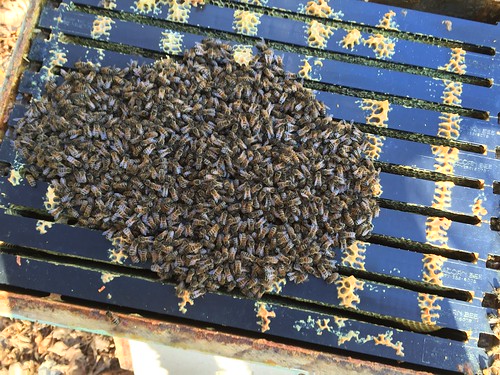
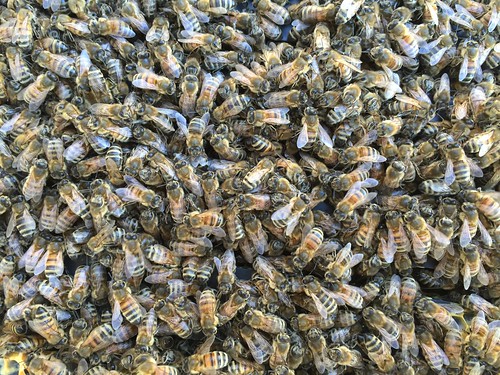
Here are pictures of my bees that I took yesterday. This is the top box of the smaller and larger colonies: bees IMG_4791 bees IMG_4798

And a close-up:
bees IMG_4799

Here's the new sunny location of the hives behind my vegetable garden.
bees IMG_4866

Thursday, January 28, 2016

mid-winter hive check

I was wondering about my bees today and so I dropped an email to Tony at my local bee club and asked if I should be checking them in the winter. The answer was "Yes, I should". But not like a summer inspection. Tony recommended suiting up, but no smoker. He said to lift hives from the back to check their weight. If light, they've used up their winter honey stores. Finally, he said, lift the cover and check the location of the bees and if they're alive. If they're at the top of the topmost hive, they likely need feeding and should be fed with a winter recipe.

So, the weight of both my hive top boxes is very heavy. That's good. But I was disappointed when I opened the hives. I wish I had seen more bees. Being my first winter, I didn't really know what to expect, but I was hoping to see more. One hive had maybe a baseball-sized cluster, the other maybe a soft-ball. Both clusters were at the top and I couldn't see more than a scattered few bees elsewhere inside the frames using my flashlight. This didn't seem good to me.

While checking them, I became concerned about the hives' location. It was a nice warm day, mid 40's, but the hives were against the woods with a northeast exposure and it was cold there. Snow had melted from most other places, but not here. Around one of the hives, a large puddle had collected on top of ice and there were drowned bees in it. This was the hive with fewer bees in it and this one also had some dysentery on the face. It was probably a hasty decision, but I decided to move the hives to the other side of my yard. I didn't feel I had much to lose because there were so few bees left.

I picked up the top frame and placed it on an inverted trash can. It was all I could do to lift it - my guess at least 60 lbs of honey. The bottom box was light. I moved the base, (a mouse was living on the dirt underneath) and brought it to its new location using a wheelbarrow. Then I moved the bottom box, then the top. I repeated with second hive. I was pleased to get a good amount of bees buzzing around in the process, though it all went fast and smoothly.

The new location has a southwest exposure - it's just to the south of my vegetable garden. It was bright and sunny during the move. The bees hung out on the face of the hives and it seemed to me they enjoyed the sunbath. The afternoon sun had melted all the snow and thawed the top few inches of soil here. I don't think the chilly old location was getting more than an hour of early morning sun.

Nevertheless, I'm not feeling really good about these hives surviving the winter. I think I'll place an order now for a spring package.

Thursday, January 21, 2016

bee hives in winter cold

winter bees IMG_4863

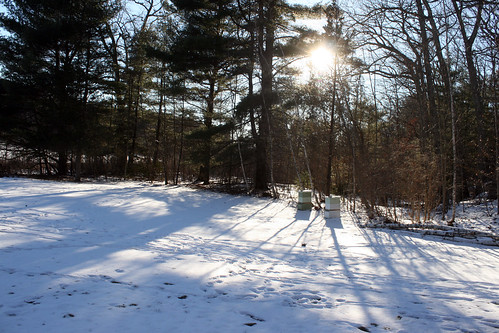
My bee hives are dwarfed by the long winter shadows. I'm wondering how the bees are doing. We've had a couple weeks of temperatures in the 20's and below. What a difference a month has made! At the end of December my bees were out pollinating hellebore.

I prepared my hives for winter back in October by installing mouse guards, adding a piece of ceiling tile to insulate the top, and making sure my top entrance was available to the bees. I don't have entrance reducers on, but I do have a slatted rack bottom board, so hopefully that's keeping the draft down inside. It's the first winter for these bees and both hives were full to the top with honey and bees in the fall. My fingers are crossed.