Friday, April 15, 2016

queen stuck in cage

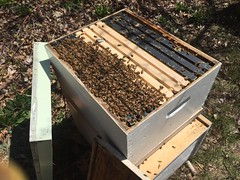
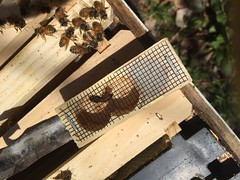
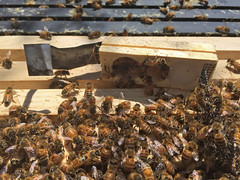
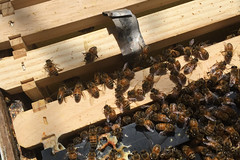
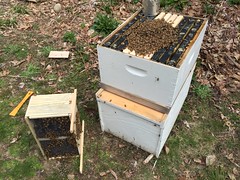
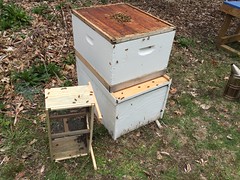
I checked on my newly installed bees this morning. The queen was still in the cage!! There was no sign that the bees were eating the candy plug at all! I can't believe it. I was so pleased that I installed the package right this time and now the bees didn't do their part!

Unfortunately, it's been 4 days since I installed them. (I had a busy week.) I hope the queen is OK still. I let her out. She looked fine. Small. I think what happened is that the bees were all to busy eating all the honey and pollen I gave them and they weren't interested in the candy plug.

bees IMG_5744 bees IMG_5746 bees IMG_5749 bees IMG_5750

Tuesday, April 12, 2016

crazy weather - lost hives

This crazy weather has had bad consequences on many things, including bees.

It's halfway into April and our weather is still chilly - rainy, dark and cold. What an odd year. After our incredibly warm February, I thought spring was here early. But now March and April have been wintry. Our early flowers were hit by frost and are now brown mush. A friend of mine lost two hives recently and she said others have had the same problem. Their bees broke their clusters in February and didn't reform when the cold hit, so they died in March. I think this happens when the queen lays early brood, the bees spread out to keep the brood warm. When cold hits, the bees don't know they can't keep all the brood warm, and the whole hive dies. Too bad - crazy weather.

(BTW- This isn't what happened to my hive - it died in the middle of the winter.)

Monday, April 11, 2016

new package installed

installing bees  IMG_5716 installing bees IMG_5721

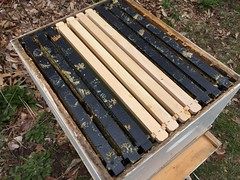
To prepare my new hive, I set up a deep box with four new frames (the ones with wood edges) in the middle and six drawn frames (the ones with black plastic edges). The two adjacent to the new frames were extracted, the other four were full of honey. I'm glad to be able to feed the new bees honey. (It's from my hive that died in the middle of the winter.) I think they'll like this better than sugar water.

installing bees  IMG_5726 installing bees IMG_5727

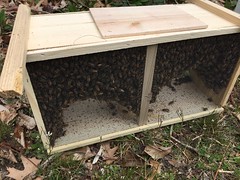
They were very nice bees. I dumped them all in the box. And I put the queen in correctly. I didn't break the metal hanger or remove the wrong plug like last year. I'll check in two days to make sure she got out.

Monday, March 21, 2016

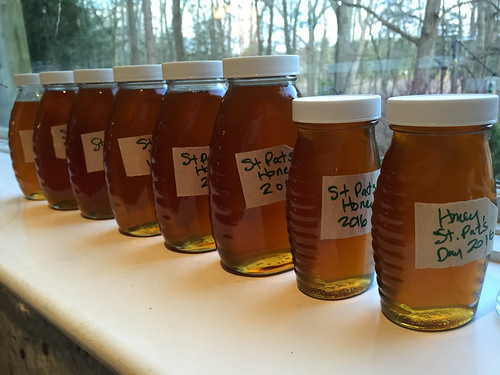
pollen in my honey - questions

I used a metal honey strainer the last two times I prepared honey. I found that the honey ends up less clear, more particulates in it. I think the particulates are pollen. Is this a good reason for using a metal strainer? Pollen in the honey is good!

The other explanation for my pollinated honey is that the honey I prepared with a cloth strainer last fall was from a honey super, while honey I prepared recently was from frames at the edges of brood boxes. Do bees add as much pollen to supers as they do to brood boxes? Lots of questions, but really delicious honey.

honey IMG_5508

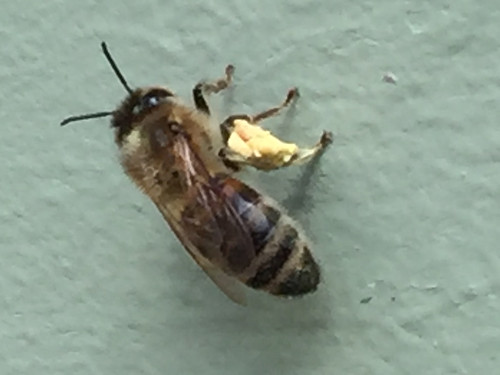
bee with early spring pollen

bee with willow pollen IMG_5491

This is one of my bees with the light yellow pollen that I think is willow pollen.

Thursday, March 17, 2016

brood!

It's St Patrick's Day. Another sunny day in the 60's - hard to believe for March.

I used an extractor yesterday to remove honey from three frames (another 15 lbs of honey for me). It's the first time I've used an extractor. I rented it - $15 for 2 days from my local bee club. Pretty good. It's a bulky piece of equipment to store at home. If the club location wasn't a 40 min drive from me, I would surely rent it regularly. But I may consider buying one instead next time.

I opened the hive today to replace two unworked frames with these newly extracted frames. I put the unworked frames in the hive last week, taking out two frames full of honey and making space for brood in my honey-bound hive.

I was so excited to see the bees' progress today! In a week, the bees had built up half of one fresh frame. Since the other fresh frame was I unworked, I took it out and substituted the extracted frame. Most exciting, there were many, very tiny, curled up larvae in the hive!!! Yeah! There's a queen and she's laying.

Last week a few bees were bringing in a very pale yellow pollen. Today many bees have this same pale yellow pollen. My guess is willow pollen. That's a big source of pollen and nectar for them. An exciting day.

Wednesday, March 9, 2016

hive check - "dewinterizing"

At midday today, I opened my second hive, my remaining live hive. The bees were very active, bringing in lots of yellow and orange pollen. I see a few scattered crocuses around in my yard, but I bet they've found another yard with many early spring crocuses and snowdrops.

Today is warm. 70F in the shade, but my thermometer is showing 94F on the sunny stone patio. Sunny and beautiful. It's the first really amazing spring day. My bees have been a bit active in previous weeks, but now they are really buzzing around.
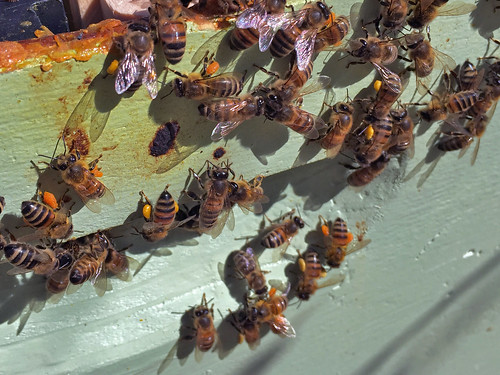
bees with pollen IMG_5319c
I opened the hive and checked all levels, pulling out about 50% of frames. My hive is two deeps at this point. There was a nice cluster of bees centered on two frames in the middle of the top box. These frames appear to have some open cells, but also cells with and uncapped honey and pollen. I don't see any eggs or brood. I did not see a queen. But then, I'm not good at spotting queens or eggs.

Aside from these two frames, the rest of the hive is 80-90% full of capped honey. Even the bottom box has a lot of honey. Maybe half of it down there is uncapped. Both boxes are very heavy, maybe 40-50 lbs for the bottom one and 60 lbs for the top. I was pleased that this hive did not have mold in the bottom box like my dead hive.

So, I am assuming that there is a queen in the middle of that cluster of bees and that she will start laying as soon, if this weather holds, and if the workers clear out some space. But I'm afraid there is too much honey in the hive. It seems it got backfilled with honey last fall.
Backfilling refers to filling an empty brood cell with honey or sometimes pollen. In other words, a cell that previously held one or more generations of developing bees, is now used to store food.

From what I read, backfilling happens in peak brooding season and checkerboarding (or moving frames around so there are empty frames available for brood) is an approach to counteract it, so the bees don't swarm. Checkerboarding is normally started at the peak of brood nest expansion, just when the nest stops getting larger and begins to shrink. But I didn't do this in the fall.

So I'm doing what I can now. I removed two full frames of capped honey (for me!) from the edges of the top box. I kept the two frames that the bees were clustered on together, and pushed the adjacent frames aside. I added in two unworked new frames here. (I wish I had empty worked frames to use instead - I'm going to think about ordering a honey extractor.) So the frame pattern looks kind of like a checkerboard. (A traditional checkerboard would also include alternating frames in the box above the brood area.) I don't think I need to add another box or reverse my boxes. I took the insulating top panel out, added a few thin sticks as spacers, and removed the mouse guard.

So, I'll leave the hive alone now for a couple weeks and then check at the end of March. I will hope to find brood then. I think it is still pretty early for bees. March 9. Last year we had a foot of snow still. I don't know when brood rearing usually starts. Greg wrote that he has brood in his hive in western CT. My new package won't come for another month - mid April.
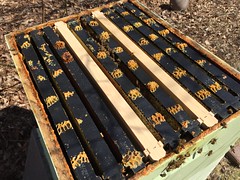
hive checkerboard IMG_5333 honey IMG_5334