Friday, January 29, 2016

bee photos

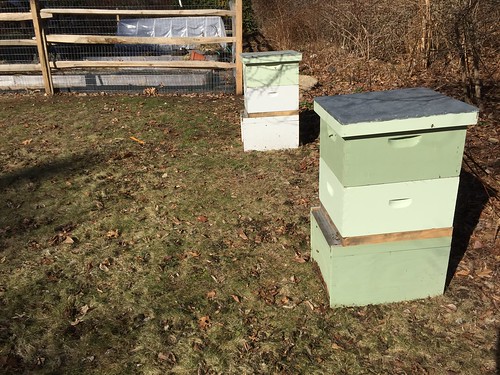
Here are pictures of my bees that I took yesterday. This is the top box of the smaller and larger colonies: bees IMG_4791 bees IMG_4798

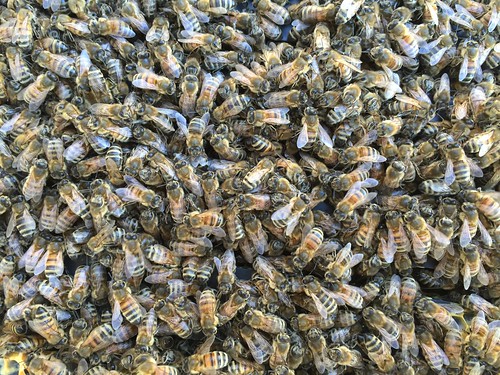
And a close-up:
bees IMG_4799

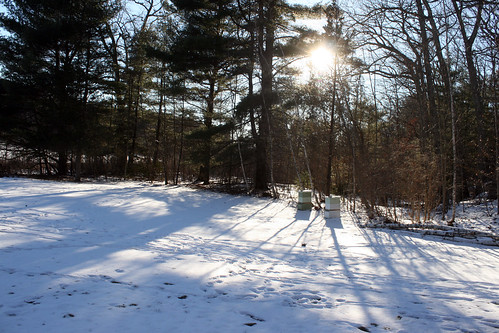
Here's the new sunny location of the hives behind my vegetable garden.
bees IMG_4866

Thursday, January 28, 2016

mid-winter hive check

I was wondering about my bees today and so I dropped an email to Tony at my local bee club and asked if I should be checking them in the winter. The answer was "Yes, I should". But not like a summer inspection. Tony recommended suiting up, but no smoker. He said to lift hives from the back to check their weight. If light, they've used up their winter honey stores. Finally, he said, lift the cover and check the location of the bees and if they're alive. If they're at the top of the topmost hive, they likely need feeding and should be fed with a winter recipe.

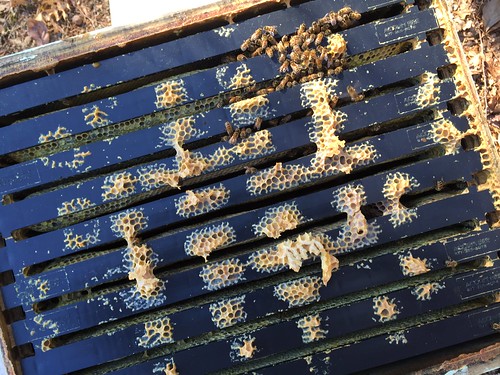
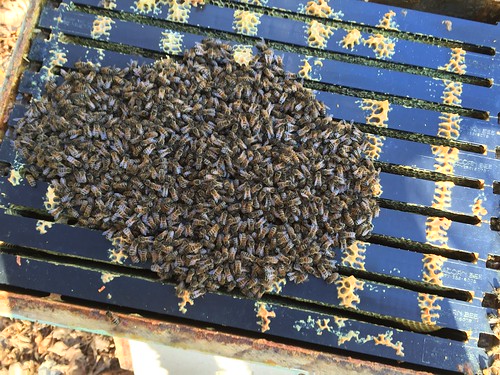
So, the weight of both my hive top boxes is very heavy. That's good. But I was disappointed when I opened the hives. I wish I had seen more bees. Being my first winter, I didn't really know what to expect, but I was hoping to see more. One hive had maybe a baseball-sized cluster, the other maybe a soft-ball. Both clusters were at the top and I couldn't see more than a scattered few bees elsewhere inside the frames using my flashlight. This didn't seem good to me.

While checking them, I became concerned about the hives' location. It was a nice warm day, mid 40's, but the hives were against the woods with a northeast exposure and it was cold there. Snow had melted from most other places, but not here. Around one of the hives, a large puddle had collected on top of ice and there were drowned bees in it. This was the hive with fewer bees in it and this one also had some dysentery on the face. It was probably a hasty decision, but I decided to move the hives to the other side of my yard. I didn't feel I had much to lose because there were so few bees left.

I picked up the top frame and placed it on an inverted trash can. It was all I could do to lift it - my guess at least 60 lbs of honey. The bottom box was light. I moved the base, (a mouse was living on the dirt underneath) and brought it to its new location using a wheelbarrow. Then I moved the bottom box, then the top. I repeated with second hive. I was pleased to get a good amount of bees buzzing around in the process, though it all went fast and smoothly.

The new location has a southwest exposure - it's just to the south of my vegetable garden. It was bright and sunny during the move. The bees hung out on the face of the hives and it seemed to me they enjoyed the sunbath. The afternoon sun had melted all the snow and thawed the top few inches of soil here. I don't think the chilly old location was getting more than an hour of early morning sun.

Nevertheless, I'm not feeling really good about these hives surviving the winter. I think I'll place an order now for a spring package.
Thursday, January 21, 2016

bee hives in winter cold

winter bees IMG_4863

My bee hives are dwarfed by the long winter shadows. I'm wondering how the bees are doing. We've had a couple weeks of temperatures in the 20's and below. What a difference a month has made! At the end of December my bees were out pollinating hellebore.

I prepared my hives for winter back in October by installing mouse guards, adding a piece of ceiling tile to insulate the top, and making sure my top entrance was available to the bees. I don't have entrance reducers on, but I do have a slatted rack bottom board, so hopefully that's keeping the draft down inside. It's the first winter for these bees and both hives were full to the top with honey and bees in the fall. My fingers are crossed.

Friday, December 25, 2015

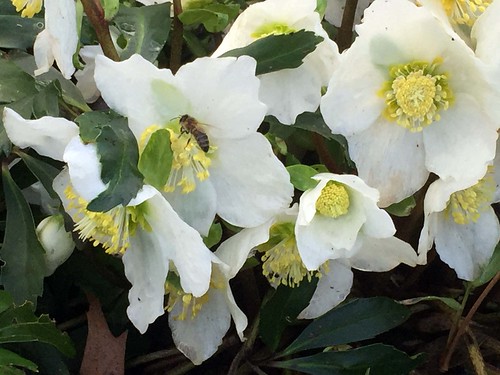
christmas day - honey bees on hellebores

dec 2015 bee on hellebores

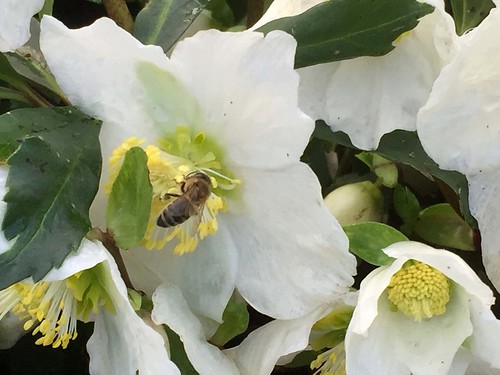
Last week the hellebore has been blooming gloriously in the misty unusually warm New England weather. Today the sun broke out. I saw my bees were out foraging. Hard to believe on the last week of the year! I found some, collecting hellebore nectar. The hive entrance was pretty active with three or 4 bees passing in and out at any one time. I didn't see any bees foraging around the pond on our afternoon boat ride. Of course - there are no flowers there. The only flowers around now are some dried dianthus and some beautiful hellebore's. This hellebore plant had several bees on it even though it was nearing sunset, 4 pm, when I checked it.

Dec 2015 bee on hellebores IMG_4485

a very warm Christmas!

My bees are out and about at the end of December! 61F now, and yesterday was a high of 68F. I don't know if this is good for them. There are no flowers. I suppose they can get a drink and stretch their wings then go back to their honey stores.

Tuesday, September 15, 2015

honey!

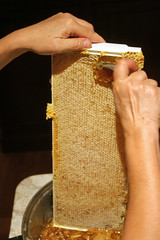
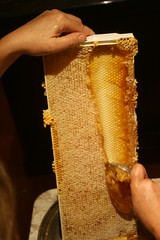
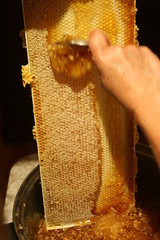
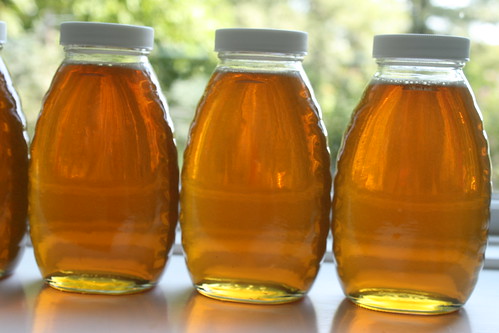
I can't quite believe it. I collected honey from my own hives! It's a cool feeling. Yesterday I opened my white hive, the healthier of my two. it has two deep boxes and one super. I checked the deeps and they are full, with the exception of the far half of one outside frame. I didn't pull out frames, just checked from the top. They are also full of lots of bees. It seems the bees have settled down - much less aggressive than they were in the heat of summer.

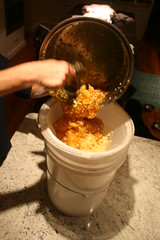
Anyway, I took all of the honey out of the super - five full frames. It was pretty easy to just tap the bees off of them. I brought the frames up to the house in a garden trug and replaced the super and honey coated queen excluder back on the hive hoping the bees will clean them up for me. Once at the house I transferred the frames to a plastic box with a lid. I made the mistake of leaving the trug outside on our patio table. It set of a small feeding frenzy as hundreds of bees came to clean out honey left in it. Pretty impressive.

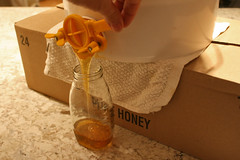
I am planning to use a honey sieve and gravity strain the honey. Five frames isn't very much for most beekeepers, so this simple method makes the most sense. Hopefully I can do that tomorrow.

I'll check my second hive soon too, but not expecting much if any honey. This hive was without a queen for a month this summer and lagged behind the other one. I'll remove what's there so I can take the supers off for winter.

honey comb IMG_3899 honey comb IMG_3904 honey comb IMG_3907
honey filtering IMG_3922 honey filtering IMG_3928
honey IMG_3937
honey IMG_3930

Wednesday, August 19, 2015

inspected!

I called the Middlesex bee inspector last week and told him I was a new beekeeper in the area. He was very quick to come by and inspect my hives. And it was exciting for me to have an expert take a look. The bottom line: I passed! Yeah. He said my hives look super.

We started first at the far side of the yard, looking over at the hives. He said they are in a good location with lots of morning sun, maybe a bit shady in the afternoon. It's good they have a nice big water source with the pond nearby. He loved to see all the purple loose strife, pepper bush and round white flowers (I forget what he called them) blooming. He wasn't concerned about the location being too damp. He looked at the hive traffic and saw my white hive is very active and the green one has fewer bees, but still very active. I explained the recent queen replacement and dip in numbers during the process.

He likes to start with the healthiest hive first, so he opened the white hive. Yes, its full of bees! I had two supers on and he said the second wasn't needed. It wasn't being filled and lots of room still in the first. He thought I'd get a good amount of honey by the end of fall, but said it's been a slow honey season for some reason this summer. So the top super came off.

He opened the hive and pulled out a few frames from the top box. Ones at edges and in the middle. Spot checking. He said its best not to bother the bees more than is needed and recommends only checking a few frames at most every three weeks. Look for laying pattern and food stores. No need to find the queen.

Then he opened the green hive. He noticed, as I had told him, how aggressive they are. They've been gradually settling down since they were without the queen. But still they are very protective. He got a good sting on his back shoulder as he was closing up. Before that he was able to check a couple frames and could see lots of food and a nice laying pattern. He said I have a good queen and even though that hive might not make honey for me this year, it was good going into winter to have a young, naturally mated queen. He thought the green hive might do better over-wintering than the white.

So all is good.

I am interested in the inspection process and kind of stumbled into it. He said he is paid by the State and likes to looks at every hive in the area once a year. He serves a function to both look for disease and to mentor beekeepers. Well, it was a very helpful experience for me!